
The New York Times quotes Neha Narula in 'Twitter and Facebook Want to Shift Power to Users. Or Do They?'
A decentralized internet was hailed as a way to dethrone Twitter and Facebook. But to the tech giants, the idea could unload some of their burdens.
By Nathaniel PopperDec. 18, 2019. The New York Times.
SAN FRANCISCO — Not so long ago, the technology behind Bitcoin was seen in Silicon Valley as the best hope for challenging the enormous, centralized power of companies like Twitter and Facebook.
Now, in an unexpected twist, the internet giants think that technology could help them solve their many problems.

Coindesk Article: 'Even if a Thousand Projects Don’t Make It, Blockchain Is Still a Change Catalyst' by DCI Advisor Gary Gensler
This post is part of CoinDesk's 2019 Year in Review, a collection of 100 op-eds, interviews and takes on the state of blockchain and the world. Gary Gensler is a professor at the MIT Sloan School of Management, Co-Director of MIT’s Fintech@CSAIL and Senior Advisor to the MIT Media Lab Digital Currency Initiative. He was formerly Chairman of the U.S. Commodity Futures Trading Commission, Under Secretary of the Treasury, and a partner at Goldman Sachs.

DCI's Neha, Rob and Gary engage in National Crisis Simulation 'Cryptocurrency and national insecurity'. Review by The Harvard Gazette
The year is 2021, and the nation is in crisis. North Korea has just tested a missile that will soon be capable of delivering a nuclear warhead to the continental U.S. The move took Washington by surprise as the project was likely funded via a new Chinese digital currency, which allowed North Korea to bypass the global banking system. In response, the National Security Council House has gathered in the White House Situation Room to formulate short- and long-term responses.
“Digital Currency Wars: A National Security Crisis Simulation” unfolded before a packed audience in Kennedy School Forum on Tuesday night. Hosted by the Economic Diplomacy Initiative and co-sponsored by the Belfer Center for Science and International Affairs, the exercise brought together administration veterans, career diplomats, and academics to dramatize a very real prospect — the rise of an encrypted digital currency that would upend the U.S. dollar’s dominance and effectively render ineffective economic sanctions, like those currently applied to North Korea.

CES Summit review by Bitcoin Magazine: 'Cryptoeconomic Systems Launched as Open-Source Journal and Conference’
MIT’s Digital Currency Initiative (DCI) has announced the launch of Cryptoeconomic Systems (CES), the name of both a forthcoming conference in March 2020 and a new, open-access journal intended to bring a scholastic level of quality in research and reviews to the world of cryptocurrency, outside of the traditional publication channels.


DCI's Tadge interviewed by Olga Kharif for Bloomberg article 'The World’s Most-Used Cryptocurrency Isn’t Bitcoin'
By Olga Kharif
September 30, 2019, 8:00 PM EDT Updated on October 1, 2019, 7:42 AM EDT
What’s the world’s most widely used cryptocurrency? If you think it’s Bitcoin, which accounts for about 70% of all the digital-asset world’s market value, you’re probably wrong.

Take the free MIT Open Course taught by DCI's Neha Narula and Tadge Dryja "MAS.S62: Cryptocurrency Engineering and Design"
Course Description
Bitcoin and other cryptographic currencies have gained attention over the years as the systems continue to evolve. This course looks at the design of Bitcoin and other cryptocurrencies and how they function in practice, focusing on cryptography, game theory, and network architecture. Future developments in smart contracts and privacy will be covered as well. Programming assignments in the course will give practical experience interacting with these currencies, so some programming experience is required. Course taught by Tadge Dryja and Neha Narula.

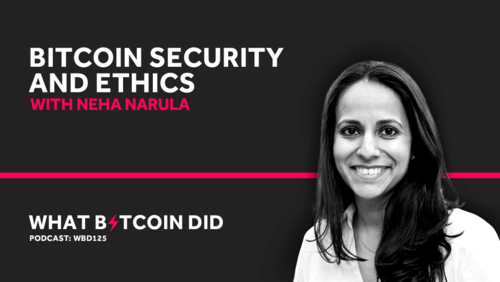
Podcast: DCI's Neha Narula was interviewed for 'WhatBitcoinDid' on Bitcoin Security and Ethics.
While I was in Boston, I sat down with Neha Narula, the Director at MIT’s Digital Currency Initiative. We discuss bugs in Bitcoin, Proof of Work being too risky and whether Bitcoin developers are ethical.

'Examining Facebook’s Proposed Cryptocurrency and Its Impact on Consumers, Investors, and the American Financial System' - Final Testimony by DCI's Gary Gensler
DCI Senior Advisor Gary Gensler’s Final Testimony on ‘Examining Facebook’s Proposed Cryptocurrency and Its Impact on Consumers, Investors, and the American Financial System’. Presented during the ‘Financial Services Committee’ at the United States House of Representatives on July 17, 2019.

Podcast: DCI's Tadge Dryja was interviewed for 'WhatBitcoinDid' on Utreexo
In this interview, I talk with Tadge Dryja, a research scientist at MIT's Digital Currency Initiative and the co-author of the Lightning Network whitepaper. Tadge recently published a new whitepaper called Utreexo, a scaling proposal for Bitcoin aimed at minimising storage requirements needed to run the Bitcoin protocol.

Utreexo: A dynamic hash-based accumulator optimized for the Bitcoin UTXO set
by Thaddeus Dryja (MIT’s Digital Currency Initiative)
Abstract: In the Bitcoin consensus network, all nodes come to agreement on the set of Unspent Transaction Outputs (The “UTXO” set). The size of this shared state is a scalability constraint for the network, as the size of the set expands as more users join the system, increasing resource requirements of all nodes. Decoupling the network’s state size from the storage requirements of individual machines would reduce hardware requirements of validating nodes. We introduce a hash based accumulator to locally represent the UTXO set, which is logarithmic in the size of the full set. Nodes attach and propagate inclusion proofs to the inputs of transactions, which along with the accumulator state, give all the information needed to validate a transaction. While the size of the inclusion proofs results in an increase in network traffic, these proofs can be discarded after verification, and aggregation methods can reduce their size to a manageable level of overhead. In our simulations of downloading Bitcoin’s blockchain up to early 2019 with 500MB of RAM allocated for caching, the proofs only add approximately 25% to the amount otherwise downloaded.
It wasn't me! Repudiability and (Un)claimability of Ring Signatures
by Sunoo Park (MIT Media Lab) and Adam Sealfon (MIT CSAIL)
To appear in the International Cryptology Conference (CRYPTO 2019).

DCI's Neha Narula Interviewed by Anderson Cooper on '60 Minutes' - 'Bitcoin's Wild Ride'
“Ten years ago, a mysterious computer programmer invented a new type of money that wasn't backed by any government or kept in any bank. There were no coins or bills, just long strings of letters and numbers stored inside a network of computers that anybody could be a part of by downloading some free software over the Internet. Today that computerized currency, bitcoin, is well-known, though little understood, and bitcoin's popularity has inspired the creation of thousands of other types of digital money, known as "cryptocurrency." Over the last decade, you could have made a five million percent profit by investing in cryptocurrency. Or you could have lost everything. It has been a wild ride, and few people have experienced the highs and lows…” Cooper. A (2019, May 19) Bitcoin’s Wild Ride.

Podcast: DCI's Neha Narula interviewed by Hari Sreenivasan for CNN's Amanpour
“Republican Senator Mitt Romney and Democratic Senator Chris Murphy join Christiane Amanpour from Washington D.C. to discuss their bipartisan trip to the Middle East and the growing tensions between the U.S. and Iran. Bill Weld, the only Republican challenging President Trump in the 2020 election talks about why he decided to run. Our Hari Sreenivasan talks to Neha Narula, the Director of the Digital Currency Initiative at the MIT Media Lab, about the future of cryptocurrencies.” Amanpour Podcast

Business of Blockchain's 'Roundtable: Stablecoins - Designing a Price-Stable Cryptocurrency' Featuring DCI's Rob Ali, MetaStable Capital's Haseeb Qureshi and Moderated by DCI's Rhys Lindmark
View this and all of the Business of Blockchain videos here

DCI's Tadge Dryja interviewed by WHAT BITCOIN DID for a podcast on 'The Limitations of Lightning'
In this episode for Lightning Month, I talk with Tadge Dryja, the co-author of the Lightning Network whitepaper. We discuss the limitations of the lightning network, why Bitcoin might not be for everyone, alternative scaling ideas, fees and inflation.

DCI's Madars Virza presents: zk-SHARKs: Combining Succinct Verification and Public Coin Setup at ZKPROOF Workshop
‘zk-SHARKs: Combining Succinct Verification and Public Coin Setup’ by Madars Virza (MIT DCI)
Madars presents at ZKPROOF Workshop on his project zk-SHARKS.
Cryptanalysis of Curl-P and Other Attacks on the IOTA Cryptocurrency
By Ethan Heilman (Boston Uni), Neha Narula (MIT Media Lab), Garrett Tanzer (Harvard), James Lovejoy (MIT Media Lab), Michael Colavita (Harvard), Madars Virza (MIT Media Lab), and Tadge Dryja (MIT Media Lab)
We present attacks on the cryptography formerly used in the IOTA blockchain, including under certain conditions the ability to forge signatures. We developed practical attacks on IOTA’s cryptographic hash function Curl-P-27, allowing us to quickly generate short colliding messages. These collisions work even for messages of the same length. Exploiting these weaknesses in Curl-P-27, we broke the EU-CMA security of the former IOTA Signature Scheme (ISS). Finally, we show that in a chosen-message setting we could forge signatures and multi-signatures of valid spending transactions (called bundles in IOTA).

DCI Mentioned in BBC's 'Should Google, Amazon and Facebook fear this woman?'
Competition authorities don't like it when big companies merge to the detriment of consumer choice, which is why Sainsbury's and Asda are finding it so hard to get their proposed tie-up past the UK's Competition and Markets Authority.
Big tech, however, is a different kettle of fish.
"As it stands, it is difficult for users to switch between platforms," notes the MIT Digital Currency Initiative and the Center for Civic Media, "and most mega-platforms do not interoperate".
In other words, once you've bought into them, you're stuck.