
Utreexo demo release 0.2
The goal of Utreexo is to make running a full node easier, faster, and smaller, and while that’s more of an asymptote than a point on any curve, we’re getting there. Today we’ve released Utreexo demonstration 0.2, which pairs the Utreexo accumulator with a modified version of btcd(temporarily called utcd). Most of the utcd work was done by Calvin Kim, as Niklas Gögge and myself have been working on improving the accumulator and how it interacts with the bitcoin data structures. Calvin has written a post about the work as well.
This new release works more like a normal bitcoin node: it starts up, finds peers, and verifies the blockchain. There are still things it doesn’t have, like a mempool, or a way to deal with reorgs. (It currently deals with reorgs by crashing.)

"Comments to the Financial Crimes Enforcement Network on Requirements for Certain Transactions Involving Convertible Virtual Currency or Digital Assets" by Neha Narula and Patrick Murck
Re: Comments to the Financial Crimes Enforcement Network on Requirements for Certain Transactions Involving Convertible Virtual Currency or Digital Assets
FinCEN Docket No. FINCEN-2020-0020, RIN 1506-AB47

Coindesk: "New MIT Paper Roundly Rejects Blockchain Voting as Solution to Election Woes"
A new report from MIT, however, strongly argues against the idea of blockchain-based e-voting, largely on the basis that it will increase cybersecurity vulnerabilities that already exist, it fails meet the unique needs of voting in political elections and it adds more issues than it fixes.

"A Fed digital currency looks inevitable. So do the problems" — American Banker's Podcast interviewing Neha Narula
By Hannah Lang November 4, 2020 9:30 PM
In American Banker’s weekly podcast “Bank Shot”, Neha Narula was interviewed by Hannah Lang on Central Bank Digital Currency (CBDC).

Neha Narula participates in "The Next Frontier in Payments and Financial Inclusion" Panel at the 2020 Global Conference by Milken Institute
FinTech offers unparalleled opportunities for financial inclusion, on both macro and micro scales. Today, payments are embedded in platforms in ways that will upend traditional commerce; crypto payments are creating new ecosystems of inclusivity between businesses and customers; and central banks are looking at digital currency to address inclusion on a national scale. This panel discussion will run the gamut of these exciting developments.

Neha Narula joins the Online Event: Digital Currency, Cross-Border Payments, and the International Monetary System
Please join the CSIS Economics Program in partnership with the OMFIF Digital Monetary Institute for a virtual webinar. This event will feature keynote remarks from Brent McIntosh, Under Secretary for International Affairs at the U.S. Department of Treasury and Kenji Okamura, Vice Minister of Finance for International Affairs at Japan’s Ministry of Finance to discuss recent digital currency developments and what they could mean for the future of the international financial and monetary systems. The keynote will be followed by an expert panel discussion to address key issues including:
The link between digital currency, cross-border payments infrastructure, and currency usage in the international financial and monetary systems.
Technology that supports digital currency and how it can meet the design requirements, specifically of central bank digital currency.
Opportunities and risks presented by digital currency to commercial banks and established payments providers.
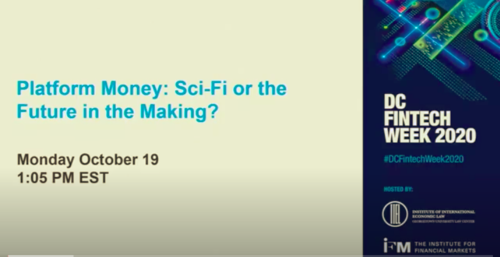
Neha Narula took part in the panel "Platform Money: Sci-Fi or the Future in the Making?" during the 2020 DC Fintech Week
There are many models for “money”--account based models and tokenized money dominate many conversations, but other pathways are breaking new ground as well, including new emoney solutions and conceptions of money as an infrastructure or platform that could support new financial applications and innovations. We talk on this panel about what’s likely--and possible.


"Responsible Vulnerability Disclosure in Cryptocurrencies" - New Paper Co-authored by Neha Narula
“Despite the focus on operating in adversarial environments, cryptocurrencies have suffered a litany of security and privacy problems. Sometimes, these issues are resolved without much fanfare following a disclosure by the individual who found the hole. In other cases, they result in costly losses due to theft, exploits, unauthorized coin creation, and destruction. These experiences provide regular fodder for outrageous news headlines. In this article, we focus on the disclosure process itself, which presents unique challenges compared to other software projects. To illustrate, we examine some recent disclosures and discuss difficulties that have arisen…”

Tadge Dryja on "Fundamental Differences between Bitcoin and Ethereum" for What Bitcoin Did
DCI’s Tadge took part in an episode of “What Bitcoin Did" with host, Peter McCormick, discussing the fundamental and technical differences between Bitcoin and Ethereum, scalability and use cases.

Neha Narula took part in "Will Digital Dollar Stablecoins & CBDC Co-Exist?" hosted by The Circle's "The Money Movement" Series
On this week's Money Movement we're joined by Visa's Head of Crypto, Cuy Sheffield; Neha Narula, the Director of MIT's Digital Currency Initiative, an institute leading research and development in crypto, digital currency and now CBDC models; and Robert Bench, AVP at the Federal Reserve Bank in Boston, and a key contributor and collaborator on the future of digital currency with the Federal Reserve.

Calvin Kim is awarded for his role as an Utreexo Collaborator: "BitMex awards its last developer grant to a Bitcoin scalability solution from MIT"
BitMex's 100x Group has awarded its last Bitcoin development grant of the year. The company has awarded a grant valued at $40,000 to Calvin Kim for his Bitcoin scalability solution, Utreexo — a project originally created by Tadge Dryja from the MIT Digital Currency Initiative.

"Brainard Says Fed Is Conducting E-Money Tests for Research" covered by Craig Torres of Bloomberg
The Federal Reserve is conducting experiments with a hypothetical digital dollar for research purposes, though it hasn’t yet committed to issuance that would require a formal policy process involving the government and other stakeholders, Governor Lael Brainard said Thursday.
In addition to the Fed’s own internal work, research teams from the Boston Fed and Massachusetts Institute of Technology are engaged in a “multi-year effort to build and test a hypothetical digital currency oriented to central bank uses,” she said…

The Boston Herald interviews Jim Cunha for "Boston Fed Bank explores cryptocurrency with MIT"
The Boston Fed is toying with a digital dollar.
The Hub’s Federal Reserve Bank is teaming up with the Massachusetts Institute of Technology to study the blockchain technology that enables cryptocurrency to be traded. And, based on the latest figures, the currency is red hot.

"The Federal Reserve Is Experimenting With a Digital Dollar" reports Nikhelish De of Coindesk
The U.S. Federal Reserve is actively investigating distributed ledger technologies and how they might be used for digitizing the dollar.
Federal Reserve Board Governor Lael Brainard said the U.S. central bank has been testing DLT over the past several years to study what a digital currency might do to the existing payments ecosystem, monetary policy, financial stability and the banking sector.
“With these important issues in mind, the Federal Reserve is active in conducting research and experimentation related to distributed ledger technologies and the potential use cases for digital currencies,” Brainard said Thursday at the Federal Reserve Bank of San Francisco’s Innovation Office Hours…

"Boston’s Federal Reserve Bank and MIT to Tackle Digital Currency Research" by Cointelegraph
The Federal Reserve Bank of Boston has entered into a partnership with the Massachusetts Institute of Technology to better understand the concept of digital currencies.
The bank will work with MIT researchers on a multiyear project to develop and test the use cases of a “hypothetical” central bank digital currency (CBDC), said Fed Governor Lael Brainard during her speech at the Federal Reserve Bank of San Francisco.
"Boston Fed, MIT partner on central bank digital currency research project" by Mike McSweeney for The Block
The Federal Reserve Bank of Boston and the Massachusetts Institute of Technology are partnering on a research effort focused on central bank digital currencies (CBDC).
Federal Reserve governor Lael Brainard spoke about the initiative during an appearance Thursday. In her remarks, Brainard touched on a variety of points around the subject of CBDC and then highlighted the work between the Boston Fed and MIT. Notably, Brainard said that any code developed as part of the initiative would be made public "for anyone to use for experimentation."

Pool Detective Lead Gert-Jaap Released a New Research Description for Pool Detective : "Who is Monitoring Mining Pools?"
One of our goals at the Digital Currency Initiative is to harden the security of cryptocurrency networks. Most users of cryptocurrency take the actual network protocol and all of its implementation — mining, pools, validation, messaging, and more — for granted, and aren’t necessarily aware of all the ways these mechanisms might be attacked or fail. For example, though mining pools are a huge part of Bitcoin’s network security, there isn’t any available public monitoring to make sure that mining pools are well-behaved. There isn’t even a standard way to look at what pool operators are doing or infrastructure to keep tabs on pool operators.

MIT DCI Collaborating With the Federal Reserve Bank of Boston to Build a Hypothetical Digital Currency
DCI will be collaborating with the Federal Reserve Bank of Boston to build a hypothetical digital currency. We are hiring a software engineer and there will also be opportunities for MIT UROPs and graduate researchers.

"MIT Lightning Creator Unveils First ‘Demonstration’ of Bitcoin Scaling Tech" by Coindesk discussing Utreexo
An article by Alyssa Hertig published on July 28th, 2020. coindesk.com
“The infrastructure propping up Bitcoin might become easier for anyone to spin up and run.
Lightning creator Tadge Dryja has been working on a new design for a lighter weight Bitcoin full node, about which he first wrote a paper in 2019. Last week, he and a team of coders released a first version of the Utreexo software as a part of MIT Digital Currency Initiative (DCI), putting the idea of lighter nodes into working code.