Public Blockchains and Regulated Financial Institutions: Key Challenges, Layered Solutions, and a Path Forward
Published June 2026
Executive Summary
Public blockchains present a compelling opportunity for financial institutions (FIs) to access open, interoperable infrastructure that can support innovation across payments, tokenization, and capital markets. However, their adoption in regulated financial services remains constrained by a set of structural risks and concerns that are inherent in their design. These risks are not easily mitigated by individual institutions and instead require coordinated action across the technology stack and regulatory environment.
This report identifies key challenges FIs face in the use of public blockchains, and focuses on four that appear straightforward, but remain unresolved: transaction front-running, transaction omission or censorship, the receipt of unsolicited tokens, and the risk of gas fees being paid to sanctioned entities. These challenges persist due to differences in perspective, risk tolerance, and design philosophies between FIs and the broader public blockchain ecosystem.
The report also identified other challenges, many of which are also experienced by non-institutional public blockchain participants. These tend to be better understood, with solutions under active development. However, even in these cases, FIs often have more stringent and nuanced requirements. For such challenges, we focus on highlighting the considerations of FIs to help ensure solutions can better address institutional needs.
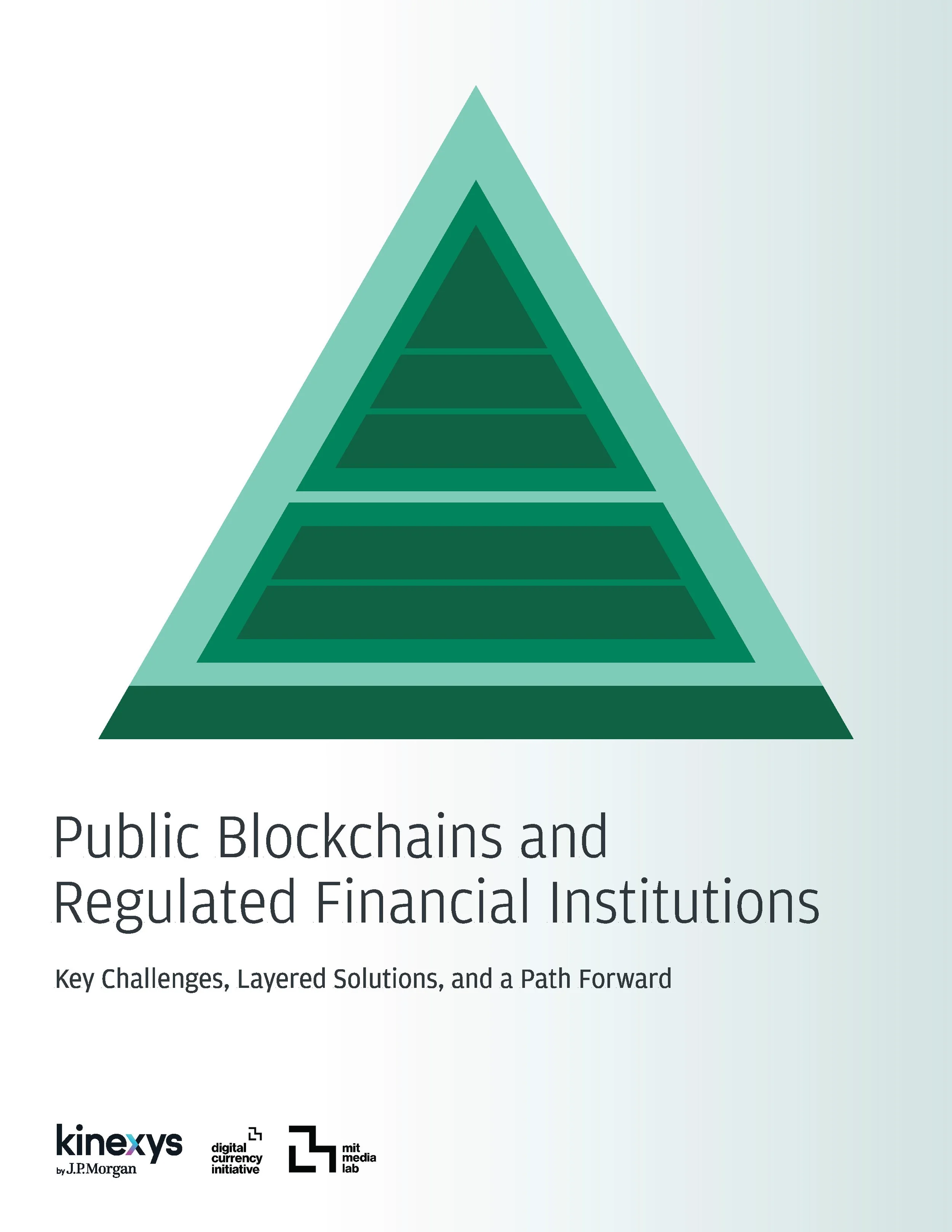
To evaluate potential responses, this report introduces a layered framework spanning application, smart contract, token standard, blockchain network, network governance, and regulatory layers. A key insight is that solutions that are most accessible to FIs, such as those at the application and smart contract layers, primarily mitigate symptoms rather than solve the root causes. By contrast, more effective and durable solutions reside at the protocol and governance layers, where FIs have limited direct control. Therefore, meaningful progress depends on collaboration between FIs, protocol developers, and policymakers.
In the near term, FIs can adopt a range of practical mitigations, including engaging with private transaction pools, designing smart contracts with enhanced controls, and implementing operational processes to manage token flows and compliance risks. While these measures can reduce exposure, they cannot fully eliminate the underlying challenges.
Over the medium to long term, more fundamental improvements are required at the blockchain network and governance layers. These include innovations such as encrypted mempools to reduce information leakage, mechanisms to improve transaction inclusion and prioritization, and adjustments to incentive structures to better align network behavior with desired outcomes. However, implementing such changes in decentralized systems is complex and requires broad ecosystem support.
Regulations are also critical. Certain risks, particularly those related to front-running, sanctions exposure, and the treatment of unsolicited tokens, cannot be fully addressed through technical means alone. Clear regulatory guidance is needed to provide legal certainty and define acceptable practices.
Ultimately, the adoption of public blockchains by FIs will depend on the ability of the ecosystem to bridge the gap between decentralized infrastructure and regulatory requirements. No single stakeholder group can resolve these challenges independently. Progress requires coordination. This report aims to support ongoing dialogue among FIs, blockchain developers, and regulators to enable secure and compliant adoption of public blockchain infrastructure.
This project was a collaboration with Kinexys Digital Payments at J.P. Morgan
Authors
Wee Kee Toh, Global Head of Business Architecture for Digital Payments, Kinexys by J.P. Morgan
Michael Maurer, Software Engineer, MIT Digital Currency Initiative
Sal Valiveti, Head of Engineering for Digital Payments and Liink, Kinexys by J.P. Morgan
Raunak Rajpuria, Head of Architecture for Digital Payments and Liink, Kinexys by J.P. Morgan
Neha Narula, Director, MIT Digital Currency Initiative
This project is a part of the Future of Financial Infrastructure research track